NVIDIA’s Robo Olympics sends simulated robots sprinting, skating, and kickboxing
Sports videos and written prompts guided OpenAI’s Astra in building the events, with NVIDIA’s simulation tools turning motion references into tested robot movements.
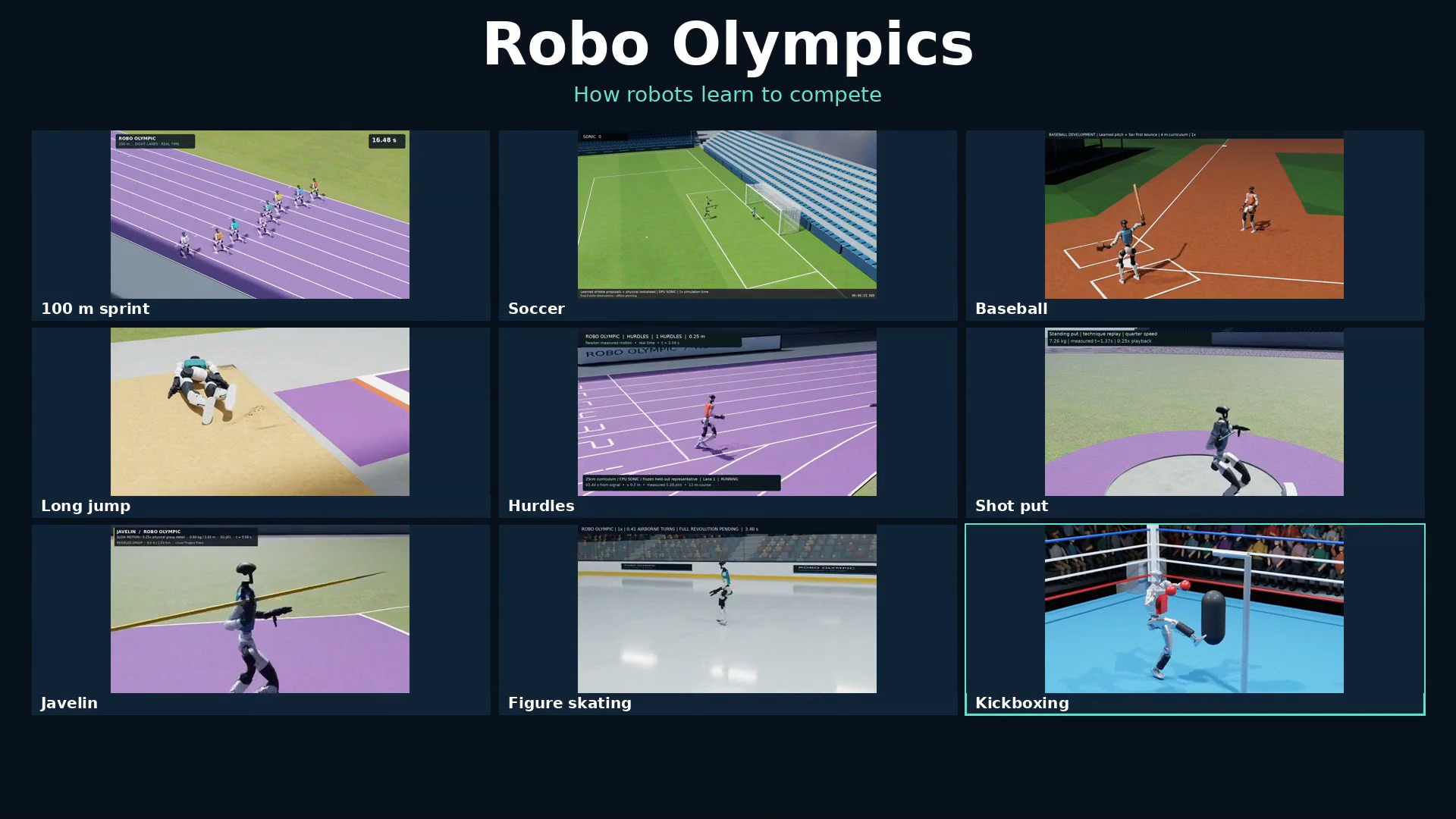
NVIDIA’s Robo Olympics (opens in a new tab) puts Unitree G1 humanoids through nine simulated sports, from clearing hurdles and throwing javelins to figure skating and kickboxing.
NVIDIA’s Tae Kim used sports videos and written instructions to guide OpenAI’s Astra AI model through building the scenes and robot controllers. Astra then revised the sport-specific controllers through repeated physics trials.
The robots started with motion references from Kimodo, an AI motion generator. SOMA Retargeter adapted those movements to robot joints, while SONIC supplied pretrained whole-body control. That gave Astra a foundation to build on for each sport.
Those movements had to hold up in Newton (opens in a new tab), the open-source physics engine used to simulate balance, forces, and contact. NVIDIA Warp handled calculations such as moving sand, and ovrtx rendered the results.
One hurdle experiment added a robot-mounted virtual camera. A perception model spotted the hurdle, and the controller adjusted its timing as the simulation ran. NVIDIA reports that the robot cleared the single hurdle in 64 of 100 trials.
More from Robotics.
Browse all stories
3D mapping · 2 min read
MultiSet Adds 3D Scan Exports for NVIDIA’s Robot Simulator
The latest update also lets devices find nearby maps automatically, combines separate survey scans, and makes mapped spaces shareable in a browser.
Spatial AI · 2 min read
AMD to Buy World Labs for $8.2 Billion
Fei-Fei Li will become AMD’s chief scientist, bringing the team behind Marble and Atlas closer to the chips that power its research.
Robotics · 2 min read
Niantic Launches 100 Real-World Scenes for Robot Training
The Places Library pairs detailed 3D scenes with physical surfaces for simulation, with free samples of a London street and a New Jersey warehouse.