
Kosmo’s New 3D Scanner Captures Gaussian Splats for Films and Robotics
Kosmo One combines LiDAR and cameras. Its cloud software can rebuild a space, move objects, and fill in areas the scan missed.
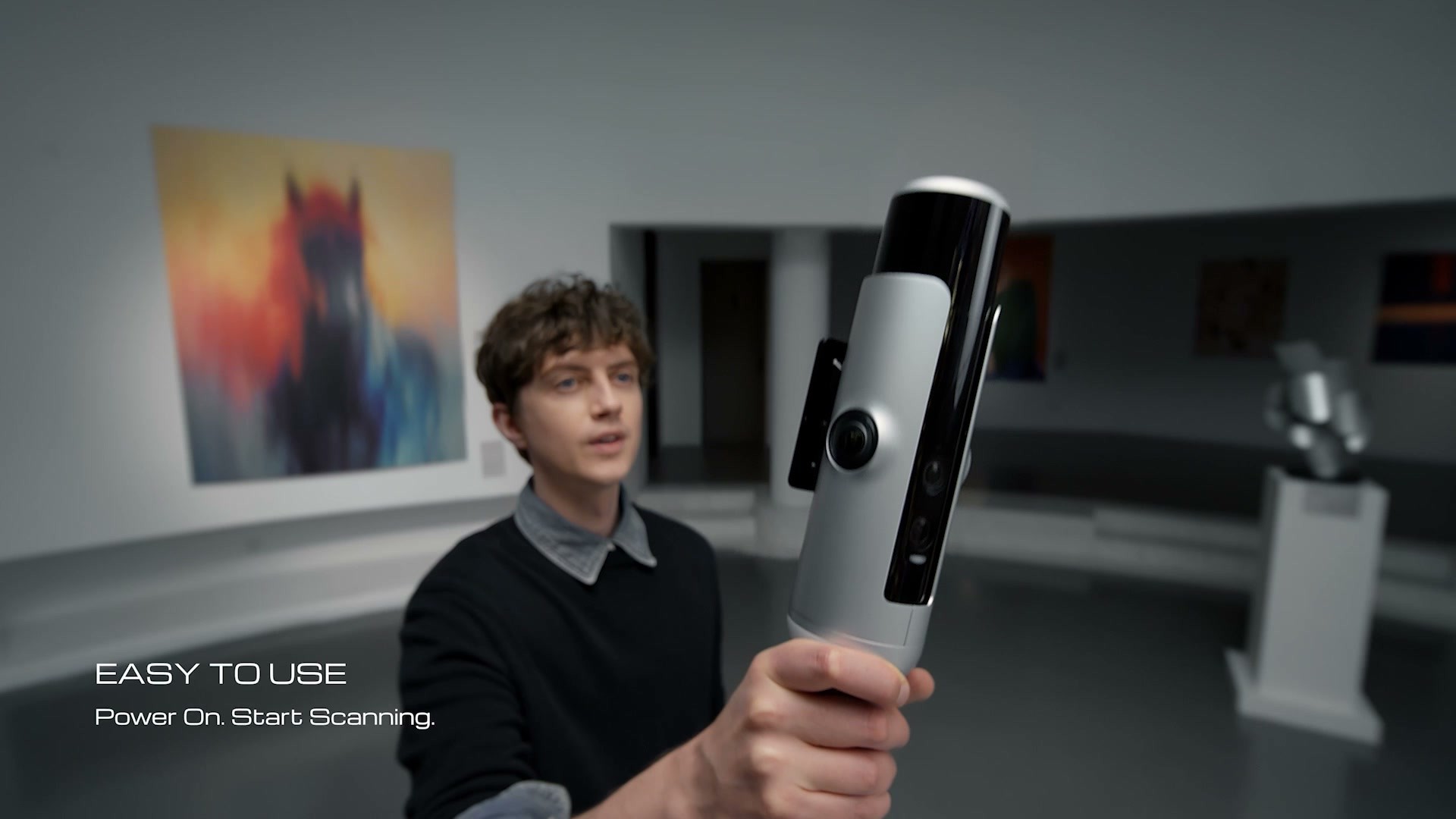
Hesai launched Kosmo One (opens in a new tab) on October 14, a handheld 3D scanner built to capture real places as Gaussian splats. It works with Kosmo World (opens in a new tab), a cloud platform that turns those scans into scenes you can explore and edit.
Gaussian splats recreate the look of a place using tiny colored shapes. You can move through the result and look around from different angles. Kosmo combines cameras that record color and detail with LiDAR, which uses lasers to measure shapes and distances.
The same capture also produces a mesh, a 3D map of surfaces, and depth data. Those give a robot simulator the shapes and distances it needs to test movement in the space.
In Kosmo’s demo, furniture can be picked out and moved around a scanned living room. AI fills in missing parts of the scene, so moving a sofa can reveal a filled-in floor beneath it.
Using a scanner supplied by Kosmo, artist Dylan Sisson captured Pixar’s outdoor plaza (opens in a new tab), then brought it into Houdini and RenderMan. Sisson turned the scan into a moving, painterly version of the same place, without rebuilding it as a conventional 3D model.
For robot developers, those scans become places to practice. Hesai’s launch announcement (opens in a new tab) lists support for NVIDIA Isaac Sim and Isaac Lab, so teams can use captured rooms in their robot simulations.
Hesai says one person can scan a typical 100 m² indoor space, about 1,076 square feet, in roughly 15 minutes. Kosmo World then processes the capture. That scan time varies with the layout and level of detail needed.
Kosmo One weighs about 1.2 kg with its battery handle. The standard battery is rated for about an hour. Its cameras capture up to 8K, while exported files top out at 6K.
Kosmo directs buyers to its sales team (opens in a new tab) and has not listed a public price. You can explore its sample scans (opens in a new tab) in your browser now.
More from Capture & Create.
Browse all stories
AI world models · 2 min read
Viggle’s JST-2 AI Model Builds 3D Worlds, Not Just Video
JST-2 tracks objects and movement in 3D, so you can explore the same scene from different angles without running the AI again.

World models · 2 min read
World Labs Rolls Out Beta Access to Its Atlas AI World Builder
Creators can build 3D scenes from reference images, set precise camera paths, and reuse generated views to extend a world.

3D capture · 2 min read
Gracia Says Its New AI Creates 3D Replays With as Few as Four Cameras
The World Reconstruction Model promises near real-time sports replays, with broader uses in film effects, 4D capture, and robot training.