
Michael Rubloff and 4DV.ai Made an 11-Minute Gaussian Splatting Video
The companion WebXR experience turns selected clips into moving places you can step inside.
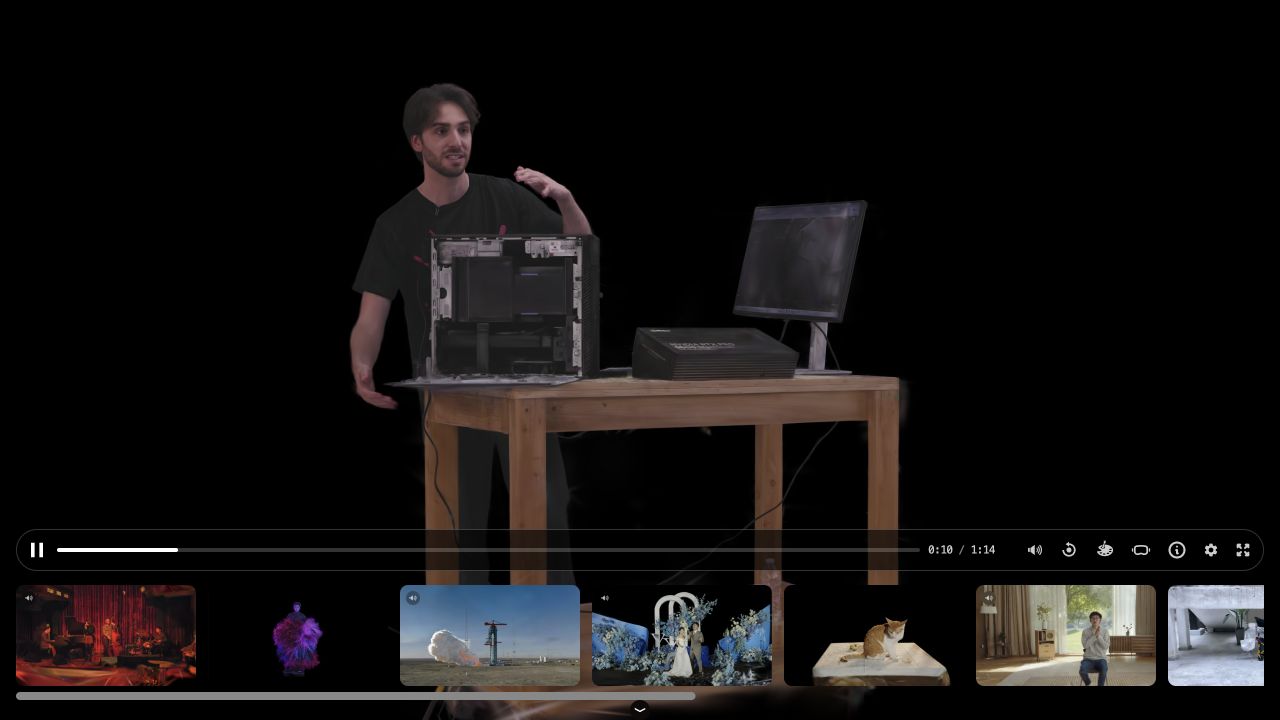
Michael Rubloff (opens in a new tab) and 4DV.ai (opens in a new tab) made an 11-minute Gaussian splatting video that moves through product demos, cooking, skin care, games, live performance, and personal memories.
The range is the point. Instead of presenting one impressive capture, Rubloff uses the full 11 minutes to explore what happens when familiar video formats become dynamic 3D scenes.
Walking through the video
Dynamic Gaussian splats are seriously cool, and if you haven’t stepped inside one yet, you really need to. YouTube cannot display the splats themselves, at least for now, so Rubloff’s 11-minute upload is a rendered video with its camera path fixed. I opened 4DV.ai’s companion WebXR experience (opens in a new tab) in Safari on Apple Vision Pro to explore the interactive side. Rubloff and a table of computer equipment first appeared inside a floating window in my room.
Tapping Enter VR made the window disappear and the scene surround me. Rubloff and the equipment kept moving at full scale while I walked around them and chose my own angle. The free viewer includes several clips to enter and explore, not just the hardware demonstration.
The same player also supports Meta Quest 3 and 3S, PICO 4 Ultra, and PC VR.
Behind the 11-minute production
Producing 11 minutes across so many setups required a full crew. Rubloff partnered with 4DV.ai, whose studio team handled the Gaussian-splat processing and technical support.
The credited crew spans producing, cinematography, audio, styling, camera operation, VFX, editing, and 3D processing. NVIDIA and Dell also supported the production, including a chapter built around a Dell Pro Max Tower with an NVIDIA RTX PRO 6000.
Rubloff is not treating the project as a one-off. He plans to move his filming exclusively to dynamic 3D over the next 12 to 18 months. On X, he described this as the last year he would create content in 2D.
Rubloff’s 11-minute video and companion WebXR scenes make that ambition easy to understand. A recorded moment no longer has to stay trapped behind the camera angle someone else chose. It can keep playing while you move through it.
Next week, I’ll publish my full interview with Rubloff on the current state of Gaussian splatting, how Apple is using it, and where the technology goes from here.
More from Capture & Create.
Browse all stories
3D mapping · 2 min read
MultiSet Adds 3D Scan Exports for NVIDIA’s Robot Simulator
The latest update also lets devices find nearby maps automatically, combines separate survey scans, and makes mapped spaces shareable in a browser.

AI tools · 2 min read
OpenAI Teases 20+ Launches at DevDay Today
An always-on AI agent and new model access are reportedly on the way, with Sam Altman’s keynote streaming free at 10 a.m. Pacific.

Spatial AI · 2 min read
AMD to Buy World Labs for $8.2 Billion
Fei-Fei Li will become AMD’s chief scientist, bringing the team behind Marble and Atlas closer to the chips that power its research.