
The NBA Is Experimenting With 4D Gaussian Splats
Peripheral Labs worked with the Raptors at NBA Summer League, showing how real basketball can become a free-moving 3D scene.
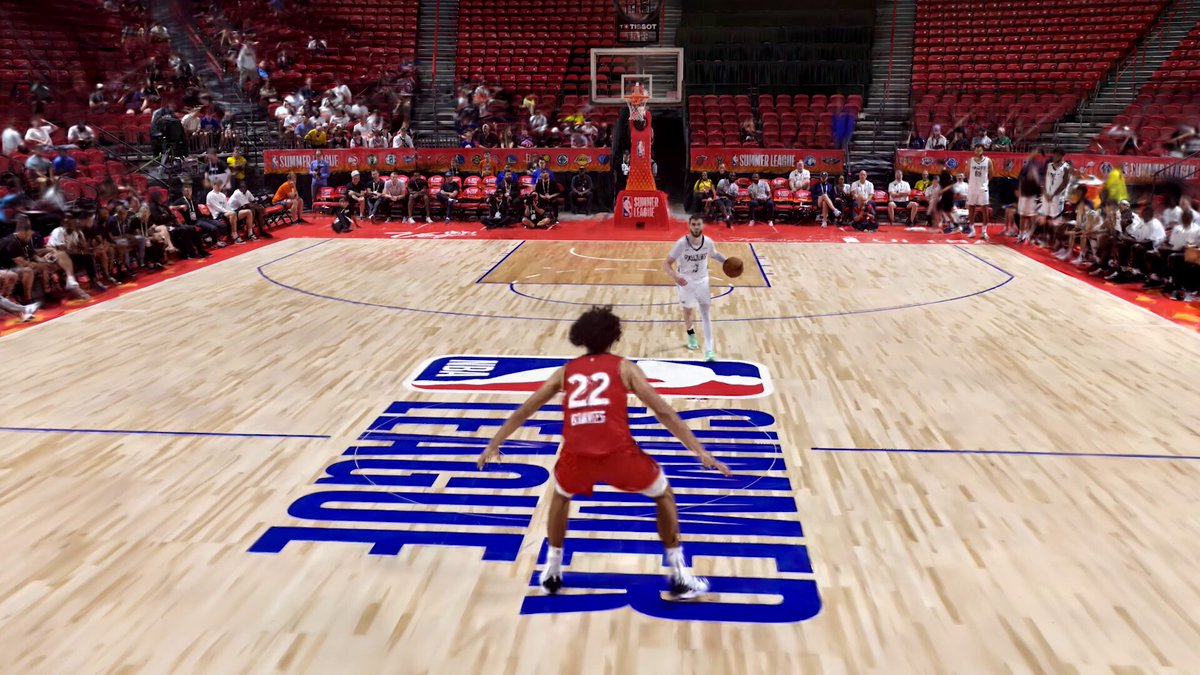
The NBA is testing technology that turns real basketball into 3D scenes you can move through.
Peripheral Labs demonstrated it with the Toronto Raptors at NBA Summer League. The virtual camera begins behind a defender near center court, follows the Pacers into the lane, then floats toward the baseline as Seth Lundy makes the game-saving block in Toronto’s 94–93 win over Indiana.
The block gives the clip a great ending. The exciting part is that the camera was never there. The players, ball, court, and arena have been reconstructed as a spatial replay, so the viewpoint can move independently of the cameras that captured the game.
The replay has no fixed camera
A normal replay can only cut between the angles a production crew recorded. Peripheral captures the court from many viewpoints, reconstructs the moving action in 3D, and lets a virtual camera travel through the result afterward.
The clip has the telltale appearance of a dynamic Gaussian splat. Players remain recognizable while their edges sometimes break into soft, translucent fragments. It does not look like a polished video game, because it is not one. It is the captured possession being rendered from a new point in space.
Peripheral describes its technology as volumetric video and spatial intelligence rather than identifying the rendering method used for this particular clip. The NBA has not released a technical breakdown, so Gaussian splatting is the clearest reading of what we can see rather than a confirmed label from the league.
The NBA keeps bringing the game closer
This experiment fits a much bigger pattern. The NBA app is already one of the best experiences I have used on Apple Vision Pro, with live games, scores, statistics, and other information arranged throughout the space in front of you.
Its standout Tabletop view uses player and ball tracking data to recreate a live game on a small 3D court. The league has also brought select Lakers games to Apple Immersive, placing Vision Pro owners inside a 180-degree production with seven physical camera positions around the arena.
When Vision Pro launched in 2024, NBA Commissioner Adam Silver told The Hollywood Reporter (opens in a new tab), “It can take you anywhere on the floor. It can give you the perspective of a player.”
There is no announced connection between Peripheral’s replay system and the Vision Pro app. What they show together is how seriously the NBA is exploring different ways to make fans feel closer to the game.
The demo leaves a few big questions
Peripheral was selected for the NBA’s six-month Launchpad program, which gives emerging companies an opportunity to pilot technology with the NBA and WNBA. Its founders previously worked in autonomous driving and 3D perception, fields built around understanding movement through space. A basketball court is an unusually fast and unforgiving place to apply those ideas.
The Summer League clip does not tell us how quickly the replay was processed, how many cameras were used, or whether it is ready for a live broadcast. Those are the questions that will determine whether this becomes a repeatable product rather than an impressive demonstration.
For fans, this pilot is really exciting. Just imagine if you could choose any angle to watch the game live or jump back into any moment from a completely new angle. We’ll be watching closely as the new NBA season begins, both for more live Apple Immersive games and for any updates the league brings to its Vision Pro app.
More from Capture & Create.
Browse all stories
Apple Immersive · 1 min read
Red Bull’s Big Wave Surfing Is a Must-Watch on Apple Vision Pro
Red Bull’s eight-minute Apple Immersive film takes you above and below Tahiti’s massive waves, with crystal-clear underwater slow motion and incredible cinematography.
3D mapping · 2 min read
MultiSet Adds 3D Scan Exports for NVIDIA’s Robot Simulator
The latest update also lets devices find nearby maps automatically, combines separate survey scans, and makes mapped spaces shareable in a browser.
AI tools · 2 min read
OpenAI Teases 20+ Launches at DevDay Today
An always-on AI agent and new model access are reportedly on the way, with Sam Altman’s keynote streaming free at 10 a.m. Pacific.